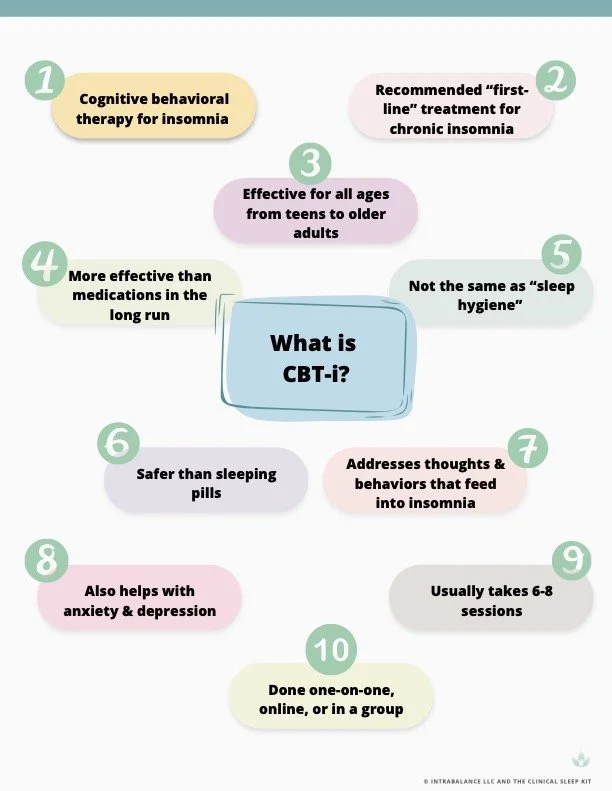
What is CBT-I?
Cognitive Behavioral Therapy for Insomnia (CBT-I) is a structured treatment that uses cognitive and behavioral strategies to improve sleep for people with chronic insomnia. Research has shown it to work as well short-term, and better long term than sleep medications, without the side effects.
Is it for you?
You are ready to understand what is getting in the way of healthy sleep and you are willing to try something that has worked to improve sleep for 70-80% of people who complete the 6 week program.
You would benefit from a strong initial assessment, an approach geared to you, and ongoing support and coaching from a human.
***If you have diagnosed medical conditions, including sleep apnea, CBT-I may not be right for you. Please always check with your physician if CBT-I could be helpful as an adjunct therapy.
Why CBT-I?
The American College of Physicians (ACP), and the American Academy of Sleep Medicine (AASM) both recommend cognitive behavioral therapy for insomnia is recommended as first-line, gold-standard treatment for chronic insomnia.
What if I don’t meet the criteria for Chronic Insomnia?
Many of the strategies of CBT-I are helpful for anyone struggling with sleep. Sleep issues are incredibly common. Especially if you are dealing with neurodivergence, or life transitions, a thorough assessment can help us create a plan so that it does not become a chronic issue
Ongoing sleep issues are usually more complex than fixing your lifestyle habits and environment (Cold room, alcohol and caffeine…). These can be helpful, but are not the whole picture.
Understanding and improving your circadian timing, sleep drive and/or hyperarousal issues can really shift sleep quality.
A thorough assessment is essential to creating a real program for sleep improvement geared to you.
CBT-I and Sleep Strategies
In a 6-7 week CBT-I program, we will cover all of the following. For less chronic sleep issues, we will utilize the skills that will best help you.
Skills You’ll Gain:
Education and Assessment: Understanding myths and facts about sleep and your individual sleep patterns,
Increasing your Sleep Efficiency: Understanding, Tracking and Improving Sleep Efficiency
Stimulus Control Therapy: Retraining the brain to associate the bed and the bedroom with sleep.
Relaxation Training: Learning and practicing ways to deal with hyperarousal (body and/or brain are not cooperating with relaxing before and during sleep times).
Cognitive Restructuring: Replacing the unhelpful thoughts and worry with realistic beliefs
Sleep Hygiene: And then, looking at lifestyle and environmental habits.